Brick Veneer in Chilliwack, BC. The look of brick, installed as a rainscreen that actually drains.
Anchored and thin brick veneer for new homes, additions, and re-clads across Chilliwack. Proper cavity, flashing, and weeps, not brick glued to a wall.
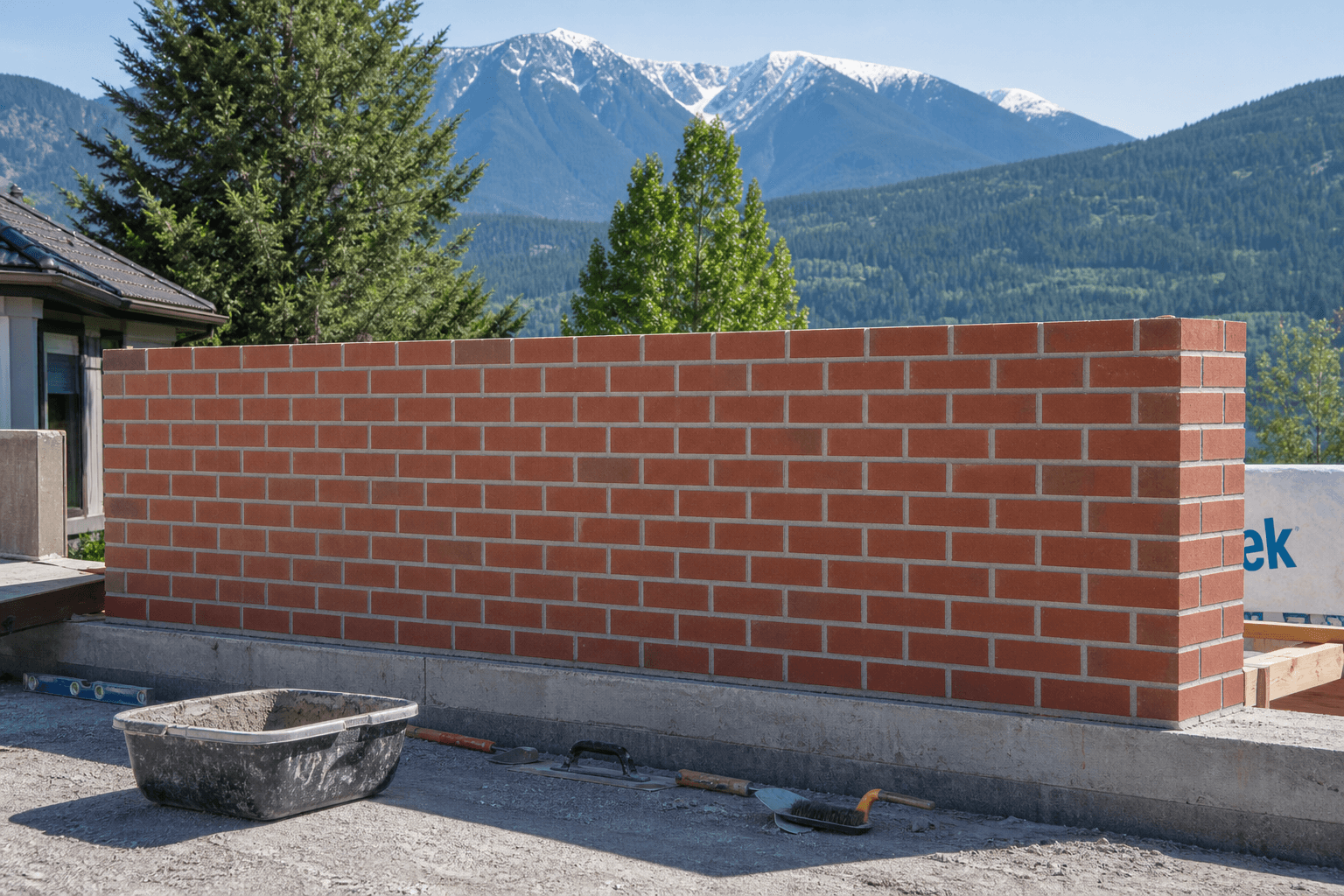
Brick Veneer in Chilliwack. What We Do
Brick veneer in Chilliwack, BC is the way most "brick houses" around here are actually built. A single wythe of brick, tied to a wood-frame wall, with a drainage cavity behind it. It isn't structural. It isn't glued-on tile. Done right, it's a rainscreen. Done wrong, it's a wet blanket against your sheathing.
If you're searching brick veneer, you might be building new, re-cladding a wall, or trying to figure out why the brick on your 1990s Sardis home has white staining and a few popped faces. Those are three different jobs. They share one rule: brick lets water through, so the wall behind it has to drain.
Anchored brick veneer uses full-thickness brick (about 90 mm), a 25 mm air space, corrugated or wire ties into the studs, through-wall flashing, and weep holes at the bottom. Thin brick and adhered brick are a different system. They have no natural cavity, so they need a rainscreen mat and a weep screed, the same way adhered stone does.
A lot of veneer in the Fraser Valley was installed when everyone assumed brick was waterproof. It isn't. Wind-driven rain gets through the brick and the joints. If the weeps are buried in mulch, the flashing was never turned up the backup, or the cavity is full of mortar droppings, that water has nowhere to go. That's when you get rot, mould, and a brick face that still looks "pretty good" from the driveway.
What's Included
- Anchored brick veneer on new construction and additions
- Thin brick and adhered brick veneer with a rainscreen
- Brick veneer repairs: weeps, flashing, loose brick, rusted lintels
- Window and door flashing integration
- Shelf angles and movement joints on taller walls
- Re-cladding sections of failed veneer
- Matching existing veneer brick for infill and extensions
When to Call a Masonry Contractor
New home or addition that should look like brick
Veneer gives you the brick look without a solid masonry wall. We build it as a drained cavity wall, not as decoration stuck on framing.
A home inspection flagged the brick
Inspectors look for missing weeps, rusted lintels, stair-step cracks, and staining. We read the report, quote the line items, and write a scope a closing agent can live with.
White staining or wet sheathing
Efflorescence on veneer usually means water is moving through the brick and evaporating on the face. If it's also wet inside, the cavity isn't draining.
Bricks dropping above windows
That's often a rusted steel lintel expanding (rust jacking), not just bad bricks. The lintel has to come out. Patching the faces doesn't stop it.
Brick veneer and 1,600 mm of Fraser Valley rain
Brick veneer was perfected in climates that get rain, which is good, because we do. The whole point of the 1-inch cavity is to let water that gets through the brick run down the back face, hit the flashing, and leave through the weeps. That only works if the cavity is open, the flashing is in the right place, and the weeps aren't buried.
Weeps should sit above grade, typically every 600 mm (every third brick, or 24 inches). Landscapers love to pile soil and bark against the bottom course. That's how weeps disappear. Then the cavity holds water all winter.
Freeze-thaw still attacks the brick faces, especially on unsheltered west and south walls. A breathable sealer can help after the drainage is right. Sealing a wall that can't drain just changes where the water sits.
Materials and Methods
Full-bed clay brick veneer
Standard 90 mm brick, tied to the backup. Best drainage when the cavity is kept clear. This is what most Fraser Valley 'brick homes' are.
Thin brick / adhered brick
Real or manufactured brick, thinner, set on lath. Needs a rainscreen and weep screed. Popular on fireplaces and feature walls where full brick is too heavy or too thick.
Wall ties and anchors
Corrugated ties are limited to a 25 mm cavity. Wire ties can span a bit more. Spacing and corrosion resistance matter. Galvanized or stainless in this climate, not bare steel.
Through-wall flashing
Flashing at the base, above windows, at shelf angles, and at roof-to-wall intersections. It has to extend to the face of the brick and kick out, not stop halfway and dump water into the wall.
What Drives the Cost
Nobody should expect a fake square-foot price from a website. Access, height, matching, and what's behind the masonry move the number more than the brochure photo. Here's what we look at before we quote.
Storeys and scaffolding
One-storey veneer from the ground is a different price than a gable that needs a scaffold. Access is usually the second-biggest cost after the brick.
Openings
Every window and door needs flashing, a lintel, and extra cuts. A wall with a lot of glass costs more per square foot than a blank elevation.
Matching existing veneer
Extending or repairing 30-year-old veneer means finding a brick that blends. Sometimes that's a current production run. Sometimes it's salvage.
Repairs behind the brick
If the cavity has been wet for years, sheathing and framing may need work before new veneer goes on. We open a section and tell you before we re-skin the whole wall.
What Goes Wrong When It's Done Cheap
Treating brick as waterproof
Brick is a cladding, not a raincoat. The WRB behind the cavity is the water barrier. If someone skipped flashing because 'it's brick,' the wall will leak.
Mortar-clogged cavities
As brick is laid, mortar squeezes out the back. Without a mortar net or careful tooling, droppings pile up on the flashing and block the weeps.
Weeps buried by landscaping
If you can't see the weeps, they aren't working. Keep soil and bark below the flashing line.
Painting brick veneer
Paint traps moisture in a material that needs to dry. If you want colour, pick a different brick. We don't recommend painting veneer in this climate.
Our Brick Veneer Process
Wall assessment or new-build layout
On existing homes we check weeps, flashing, lintels, and the backup. On new work we coordinate with the framer and the WRB installer so the cavity can actually drain.
WRB, flashing, and weeps
Housewrap or building paper, through-wall flashing turned up the backup at least 200 mm, weeps at the base and above openings.
First course and ties
The first course sits on the flashing, not in the dirt. Ties go in as we lay, at the spacing the wall needs.
Coursing, lintels, and movement joints
Windows get proper steel lintels with end bearing. Long walls get movement joints so the veneer can expand without cracking.
Cleanup and weep check
We confirm weeps are open, flashing is visible where it should be, and the site is clean.
How to tell if your Chilliwack home is veneer or solid brick
Look at the window openings. On veneer, you'll usually see a single brick thickness, and often a steel lintel. On solid brick, the wall is deeper, the jambs show more than one wythe, and the brick may continue past the interior plaster. Walk the basement. If you see wood studs and sheathing behind the brick, it's veneer. Almost every brick house in Chilliwack, Abbotsford, and Sardis built after the mid-century is veneer.
That doesn't make it cheap construction. It makes it a cladding system. Treat it like one and it lasts. Treat it like a solid wall that 'doesn't need flashing' and it doesn't.
Brick veneer vs brick masonry
Brick masonry is the broader craft: walls, pillars, steps, repairs, anything laid in brick. Brick veneer is a specific wall system. If you searched brick veneer, you're in the right place. If you need a garden wall or a chimney, those are different pages, and different builds.
Why Choose Chilliwack Masonry Works?
- We build veneer as a rainscreen, not as decoration
- Flashing and weeps are part of the job, not an extra
- We diagnose rusted lintels instead of patching the brick that dropped
- Thin brick and full-bed veneer, depending on the wall
- Written scopes that match home-inspection line items
Masonry Contractor Serving Chilliwack & the Fraser Valley
We provide brick veneer services across Chilliwack and the greater Fraser Valley, including Abbotsford, Hope, Agassiz, Mission, Sardis, and surrounding communities. See all service areas →
FAQ
Brick Veneer in Chilliwack. Common Questions
No. Brick veneer carries its own weight and is tied to the backup wall. The wood frame (or steel, or block) carries the building. That's why flashing, ties, and weeps matter so much. The brick is a skin.
Ready to start?
Ready for Brick Veneer in Chilliwack?
Call us or fill out the form. We'll come take a look and give you a clear, written quote.